

Operational Technology (OT) Cybersecurity: Why OT Cybersecurity is Now a Necessity
In recent years, organizations across manufacturing, energy, and critical infrastructure have found themselves confronting a new reality: the systems that keep their physical operations running are now prime targets for cyber attackers. These systems—collectively known as Operational Technology (OT)—were once isolated, stable, and protected simply by virtue of being offline. Today, however, increased connectivity, remote access, IT/OT convergence and the lack of security by design have made OT environments vulnerable in ways never seen before. The stakes are high; a cyber incident in OT doesn’t unlike IT just doesn’t threaten data. It threatens safety, uptime, revenue, and in some cases, human life.
Below we walk through the core elements of OT cybersecurity, illustrating each concept with real‑world context and the lessons organizations have learned the hard way.
Technology That Touches the Physical World
Operational Technology encompasses the hardware and software that directly control industrial processes—programmable logic controllers (PLCs), distributed control systems (DCS), human‑machine interfaces (HMIs), and supervisory systems like SCADA. These systems run production lines, regulate pipelines, manage power grids, and control water treatment plants.
Unlike traditional IT systems, which handle data, communication, and business operations, OT systems directly manipulate physical equipment. A misconfigured OT device doesn’t just corrupt a spreadsheet—it can halt a refinery unit, overload a turbine, or change chemical dosing levels. This physical impact makes OT environments uniquely sensitive to downtime and deeply reliant on availability and consistency.
Why OT Cybersecurity Has Become a Business Imperative
A decade ago, OT attacks were rare as systems were segregated islands. Today, they’re frequent, opportunistic, and increasingly destructive. As organizations connected OT environments to corporate networks and enabled remote access for efficiency, attackers gained new pathways into formerly isolated systems.
OT cyber incidents can lead to:
- Significant safety hazards that endanger workers or the public
- Extended operational outages that halt production
- Massive financial losses, often costing millions per day
- Regulatory violations, especially in energy and critical infrastructure
- Damage to physical equipment, sometimes beyond repair
The consequences of an OT breach go far beyond data theft—they disrupt the real world. Understanding that distinction is the starting point for a modern OT cybersecurity strategy
IT and OT: Two Worlds with Different Rules
One common misconception is that OT environments can be secured using the same tools and principles used in IT. In practice, the two domains operate under very different constraints.
In IT, confidentiality is the top priority; protecting sensitive information is paramount. Systems are built to accommodate frequent patching, upgrades, and change management. The lifecycle of an IT asset is typically three to five years.
OT systems, by contrast, put safety and availability first. Downtime can stop production lines and compromise physical safety. Some industrial devices remain in operation for 20 or even 30 years, and updating them is often complicated, costly and risky. Attempting to apply aggressive IT‑style patching in OT can and will bring operations to a halt.
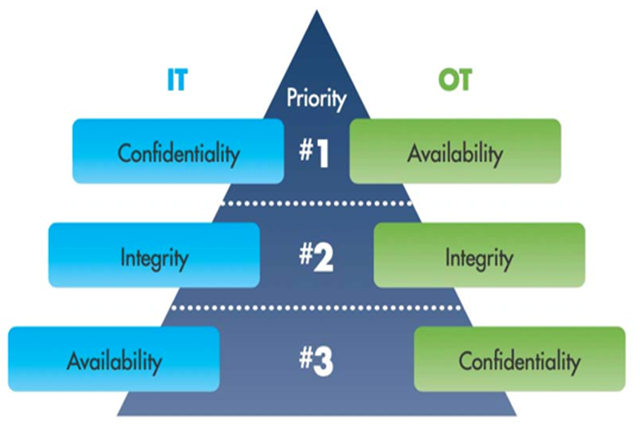
Key Differences:
- Focus: IT focuses on data security, while OT focuses on the functionality and reliability of physical processes and devices.
- Threats: IT threats often target data and financial assets, whereas OT threats can lead to physical damage, safety risks and operational downtime.
Understanding these differences is crucial. Security measures must be tailored to the operational realities of industrial systems—not imposed on them.
A Threat Landscape Designed to Exploit Weak Points
The threats facing OT environments today are varied, sophisticated, and capable of causing real‑world disruption.
Malware designed for ICS environments
The Stuxnet malware demonstrated that attackers are crafting highly specialized code targeting PLCs and industrial automation systems. Similarly, Triton went after safety instrumented systems (SIS), attempting to disable the very devices designed to protect human life.
Ransomware hitting critical infrastructure
Attacks like the Colonial Pipeline incident revealed how criminal groups can force entire industries into shutdowns. Even if OT systems aren’t directly impacted, ransomware affecting IT systems can disrupt OT operations due to interdependence.
Remote access and third-party vulnerabilities
Third‑party vendors and contractors frequently access OT networks, sometimes with minimal oversight. Compromised credentials, unsecured or poorly managed remote access portals have become one of the most common attack vectors.
These incidents highlight an essential truth: OT threats aren’t hypothetical—they’re active and evolving.
Frameworks, Models, and Strategies That Shape your OT Cybersecurity Roadmap
To navigate the complexity of securing OT environments, organizations increasingly rely on structured frameworks and industry standards. Use each of these to construct a risk-based OT Cybersecurity Roadmap.
NIST and ISA/IEC 62443
These frameworks provide guidance on risk assessment, control implementation, incident response, and secure lifecycle management tailored for industrial systems.
The Purdue Enterprise Reference Architecture
The Purdue Model remains the most widely used segmentation structure in OT. It separates industrial systems into hierarchical layers—from field devices at Level 0 to enterprise systems at Level 5—making it easier to control communication flows and limit lateral movement during an attack.
Defense‑in‑Depth
Rather than relying on a single security control, defense‑in‑depth establishes multiple overlapping layers of protection. Firewalls, network monitoring, patch management, and strict access control work together to slow attackers, detect abnormal behavior, and prevent catastrophic failures even if one control is bypassed.
Utilizing frameworks, guidelines and a defense-in-depth approach will give organizations a blueprint for resiliency and a way to translate security goals into actionable practices.
OT Cybersecurity Best Practices
Organizations that succeed in strengthening OT security often focus on several foundational practices.
Governance, policies and procedures provide clear authority, accountability, and decision-making structure. They translate risk management and security objectives into repeatable, enforceable actions that reduce human error, align IT and OT teams, and enable resilient response to cyber incidents.
OT Cybersecurity training for associates is critical because human actions are one of the most common causes of OT incidents, and informed employees are far better equipped to recognize threats, follow secure practices, and avoid mistakes that could impact safety or operations. Effective training builds a strong security culture across teams, ensuring everyone understands their role in protecting critical systems and responding appropriately to cyber events.
Network segregation and segmentation is one of the most effective ways to prevent attackers from moving freely across systems. Segregating IT networks from OT network utilizing a DMZ (De-militarized zone) structure and segmenting OT assets into tightly controlled zones limits radius of a access and any breach.
Continuous monitoring is essential for visibility. Many OT attacks begin subtly—with abnormal traffic patterns, unexpected control system changes, or unauthorized device communications. Real‑time detection helps stop intrusions before they cause damage.
Secure remote access—including multi‑factor authentication, role‑based access, and hardened VPNs—helps ensure that only authorized individuals can reach critical systems.
Together, these practices form the backbone of a proactive OT cybersecurity program.
Key Takeaways
OT cybersecurity programs are no longer optional. As industrial environments continue to modernize and integrate with IT systems, the risks will only grow. Organizations that prioritize OT cybersecurity through frameworks like IEC 62443, segmentation models like Purdue, and practices like continuous monitoring position themselves to safeguard both digital and physical assets. More importantly, they ensure the safety, reliability, and continuity of the essential services that millions of people rely on every day.